

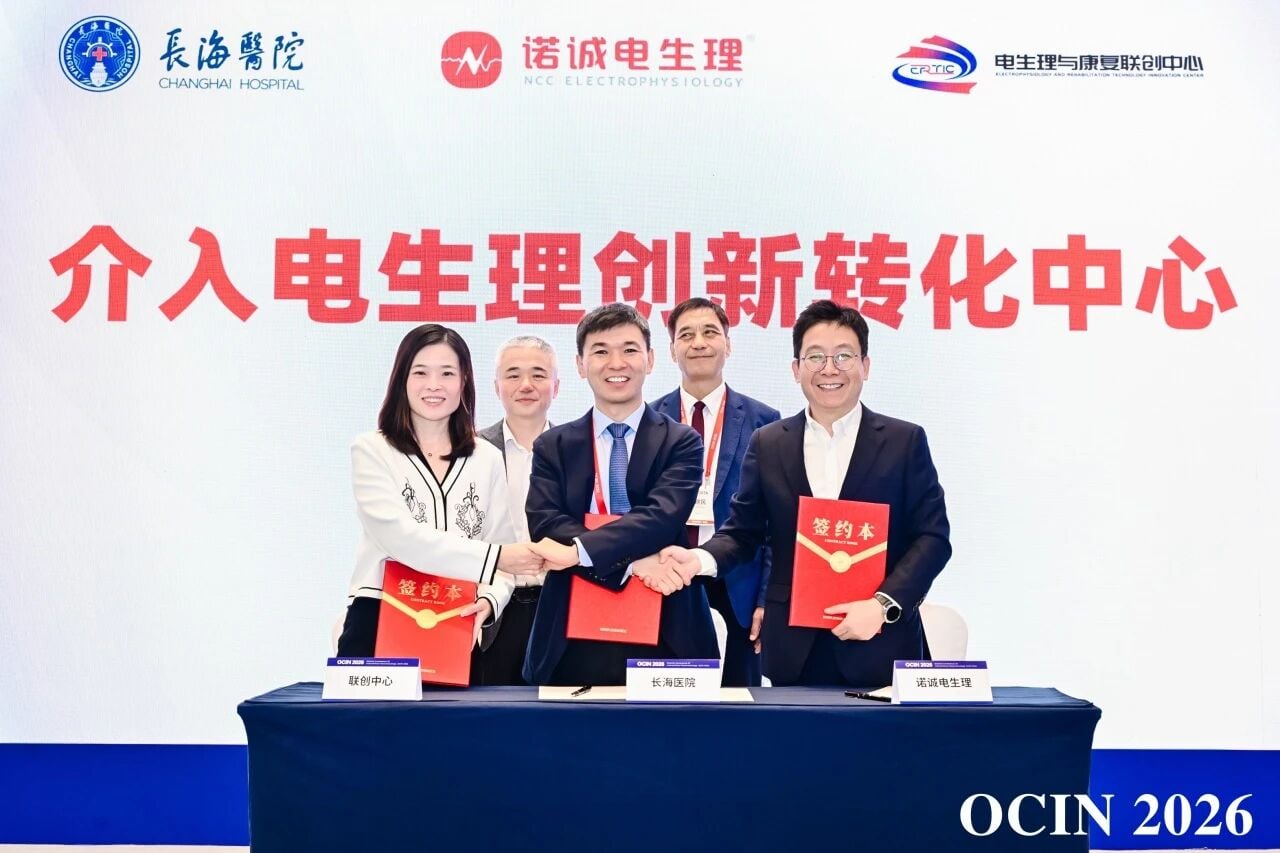
During OCIN 2026 and the Annual Academic Conference of the Stroke Branch of the Shanghai Medical Association, Shanghai NCC Electrical Co., Ltd., the Cerebrovascular Center of the First Affiliated Hospital of Naval Medical University, and the Shanghai United Electrophysiology and Rehabilitation Technology Innovation Research Center held a signing and unveiling ceremony for the Interventional Electrophysiology Innovation and Translation Center.
The establishment of the center represents a new platform for collaboration among clinical, engineering, research, and technology-translation teams in the field of interventional neurophysiology. Its work will focus on intraoperative neurophysiological monitoring for interventional procedures and on exploring pathways that connect clinical needs with technology development and potential clinical translation.
OCIN 2026 brought together clinical specialists and researchers to discuss developments in stroke care, intracranial aneurysms, cerebrovascular malformations, and neurointerventional treatment. One of the conference themes was the future angiography suite and the ways in which emerging technologies may contribute to more integrated and function-oriented interventional care.
In this context, the signing and unveiling of the Interventional Electrophysiology Innovation and Translation Center provided a concrete example of how academic discussion can lead to continued collaboration. The platform is intended to support sustained dialogue between clinical practice and technology development, with a focus on the specific requirements of neurointerventional procedures.
A future angiography suite is not defined only by the availability of advanced imaging. It also depends on how different sources of information can be organized within the clinical workflow. Imaging primarily helps visualize anatomical structures, vascular conditions, and device positioning. Intraoperative neurophysiological monitoring can provide an additional functional perspective by supporting the observation of neural activity during a procedure. Used as complementary sources of information, imaging and electrophysiological monitoring may contribute to a more comprehensive framework for intraoperative assessment.
Interventional electrophysiology is an interdisciplinary field that brings together neurointervention, electrophysiology, medical engineering, and clinical research. Developing solutions for this environment requires more than adapting existing equipment. It also requires a detailed understanding of procedural workflows, monitoring requirements, equipment integration, data transmission, and the practical conditions of the angiography suite.
The new center is intended to bring these areas closer together. Clinical teams can help identify relevant procedural needs and application scenarios. Research and engineering teams can translate those needs into technical questions and development priorities. Technology-translation resources can then support the evaluation, refinement, and further development of proposed solutions.
This collaborative model is designed to help connect the stages between clinical need and technology implementation, including:
These activities will be developed progressively and in accordance with applicable regulatory requirements, institutional procedures, and clinical evaluation needs.
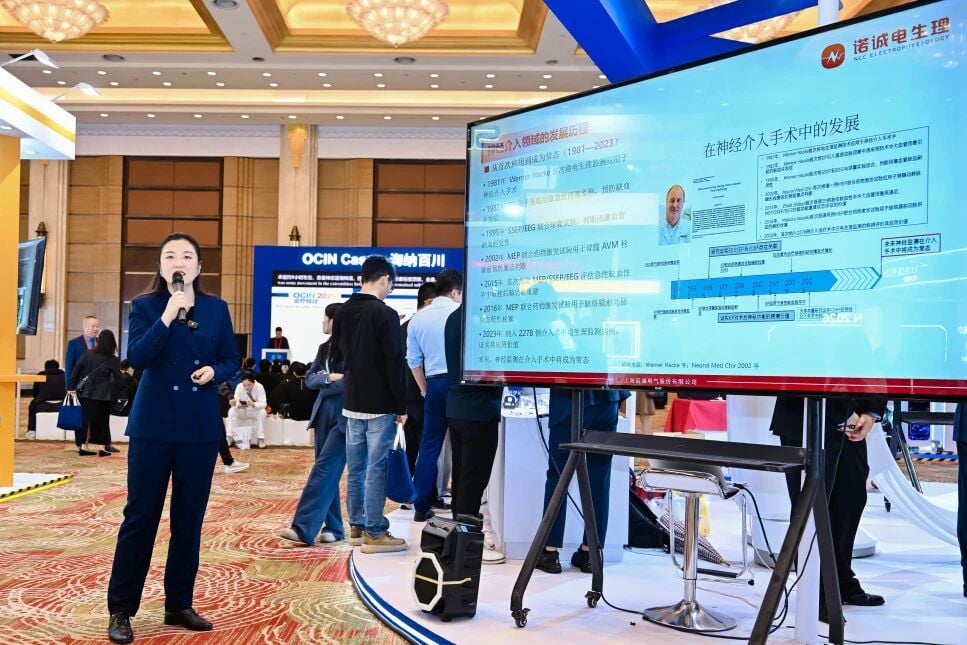
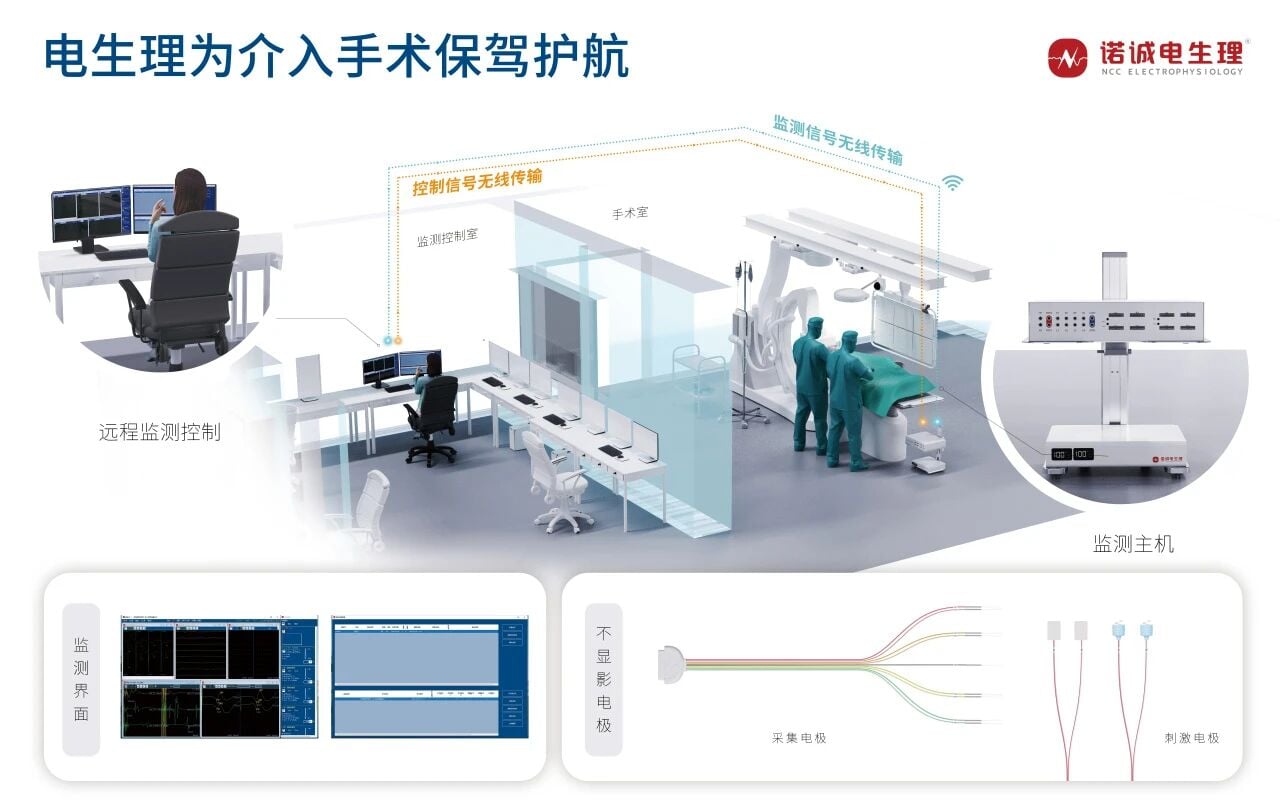
The center will focus on the potential role of intraoperative neurophysiological monitoring in interventional settings. Compared with conventional operating environments, angiography suites present specific requirements for equipment configuration, space utilization, imaging compatibility, connection design, and electromagnetic interference management.
These requirements have implications for the design and integration of monitoring systems and consumables. Radiolucent electrodes and suitable connection components may help reduce unnecessary obstruction during imaging. Data-transmission and anti-interference considerations may support the continuity of monitoring within the interventional workflow. Centralized monitoring may also provide a foundation for coordinated neurological monitoring within a hospital or, where appropriate, collaboration across multiple centers.
The development direction is not based on a single fixed monitoring model. Different interventional procedures may require different combinations of monitoring modalities and workflow configurations. For this reason, modular software, procedure-oriented monitoring protocols, and flexible multimodal configurations are among the areas that may be explored through continued clinical and engineering collaboration.
These are technology-development and implementation directions. Their practical value and suitability must be assessed through appropriate technical, clinical, regulatory, and institutional processes.
The establishment of the Interventional Electrophysiology Innovation and Translation Center reflects a shared interest in making innovation more closely connected to clinical practice. In the field of neurointervention, the translation of a monitoring concept into a usable clinical solution may involve multiple stages, from identifying a clinical problem and developing a technical approach to validating prototypes and refining the solution according to application feedback.
A collaborative platform can help bring these stages into a more coordinated process. It can also provide a setting for clinicians, researchers, engineers, and industry representatives to discuss the feasibility of proposed solutions from different perspectives. This type of cooperation is important when a technology must function within a complex procedure, interact with existing equipment, and meet the requirements of real-world clinical workflows.
For NCC Medical, the center provides an opportunity to continue exploring interventional neurophysiological monitoring in close dialogue with clinical and research partners. The focus will remain on clinically relevant requirements, responsible technology development, and practical pathways for translation rather than on isolated product development.
The signing and unveiling of the Interventional Electrophysiology Innovation and Translation Center during OCIN 2026 marks a further step in the discussion of future angiography-suite development. It connects the conference themes of neurointerventional innovation, functional monitoring, and clinical-engineering collaboration with a continuing platform for joint exploration.
NCC Medical will continue working with clinical, research, and technology partners to examine how intraoperative neurophysiological monitoring may complement imaging and support the development of more integrated interventional workflows. Through sustained collaboration and careful evaluation, the partners will explore how clinical needs can inform practical monitoring solutions for the evolving field of neurointervention.

Copyright © NCC Medical Co., Ltd. - Privacy policy
 EN